How to tell a trawler from a longliner in satellite imagery
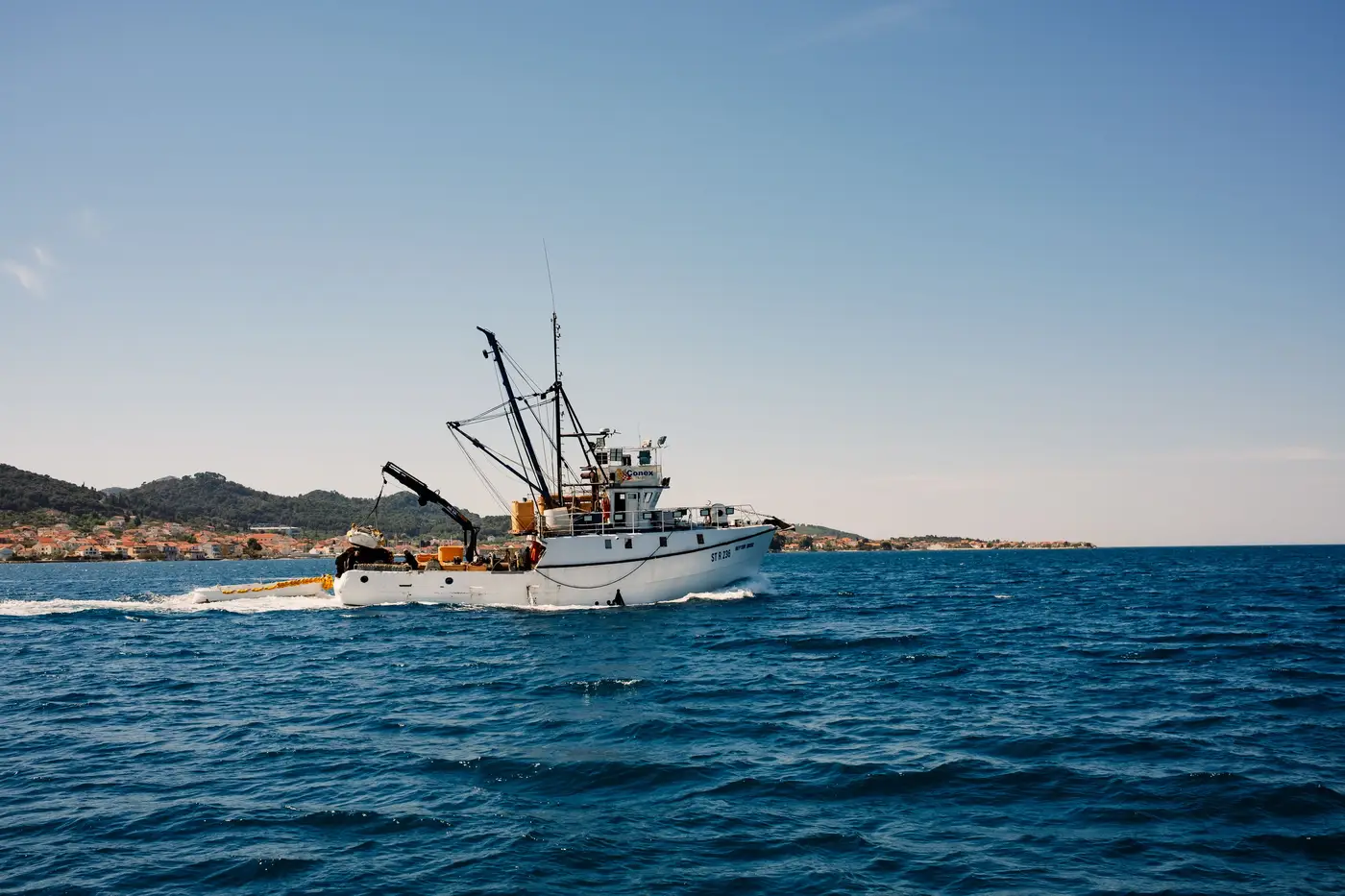
When a detection comes back with no AIS match, the first question on the watch floor isn't "whose boat is this." It's "what kind of boat is this." Gear type narrows the search fast: a trawler working a dark track in a closed area reads very differently from a longliner sitting still over a seamount, and the call you make on patrol asset priority usually starts with that read.
At 0.5-2 m resolution you're not counting rivets. You're reading silhouette, deck clutter and stern geometry, the same way a boarding officer reads a vessel from a RIB before they're close enough to read the name on the transom. Here's what holds up at that resolution.
Hull shape and deck layout
Trawlers tend to run a stockier beam-to-length ratio than longliners, built to take the strain of towing rather than to cover long transits efficiently. On an overhead shot, a trawler's working deck is usually open and uncluttered aft, with gear concentrated at the stern. Longliners run longer and narrower, with gear spread along the full length of the deck rather than bunched at one end, because the line itself is the gear.
Deck clutter is the other tell. A longliner under way will often show evenly spaced shapes along the rail: bait boxes, buoy racks, sometimes the shadow line of outrigger arms deployed to either side when the gear is set. A trawler's deck signature is simpler and more concentrated toward the stern, where the net and warps live.
Stern gear signatures
This is where gear type classification actually gets decided, and it's the single most useful feature on an optical hit. A trawler shows a stern ramp or gallows frame, visible as a distinct rectangular or A-frame shadow at the transom, sometimes with the net drum sitting just forward of it on deck. If the vessel is actively towing, you may also pick up the warp lines as faint linear features trailing aft, and the wake itself often looks different: a straighter, more sustained track than the stop-start pattern of a vessel setting and hauling gear.
A longliner's stern tells a different story. No ramp, no gallows. Instead you're looking for a line reel or hauler mounted further forward, and the wake pattern tends to show repeated slow passes or drift, consistent with setting or hauling a line that can run for miles. Longliners also spend more time stationary or near-stationary relative to trawlers, so a detection with little to no wake and a narrow hull profile leans longliner before you've even looked at the stern.
Purse seiners and gillnetters have their own signatures too: skiff stowed on a stern ramp for a seiner, net reels along the rail for a gillnetter. But trawler-versus-longliner is the comparison that comes up most on a dark-fleet watch, because both gear types show up regularly in the same grounds and get confused at a glance.
Where this breaks down
None of this is certain from a single frame. Resolution, sun angle, sea state and vessel size class all affect how much of this detail resolves. A 15 m coastal longliner and a small trawler of similar length can look close enough that the call comes down to a judgment, not a clean measurement, and smaller vessels in particular lose the fine detail that separates the two gear types cleanly. Hybrid or multi-purpose vessels that switch gear seasonally don't read consistently either. An optical gear-type call is a starting point for a boarding decision, best treated as a lead for the duty officer to weigh alongside track history and area closures.
This kind of read is exactly what a daily list of unmatched detections is for, flagging the dark hits worth a closer look before you decide whether a patrol boat needs to go find out for itself. If your team is still trawling AIS gaps by hand to build that list, Illegal Fishing Detection runs the optical-to-AIS correlation daily and hands you the unmatched detections with position, size class and time, ready for the watch desk.